How to do the Gibbon Walk: A Translation of the Pulling Book (ca. 186 BCE)
An annotated translation of the Zhangjiashan Yinshu 引書, the earliest extant treatise on therapeutic exercise of the second century BCE, with photographs of the original bamboo text manuscript, explanatory footnotes, and an edition of the Chinese text.
by Vivienne Lo 羅維前
Needham Research Institute Working Papers: 3
ISBN 978-0-9546771-2-1
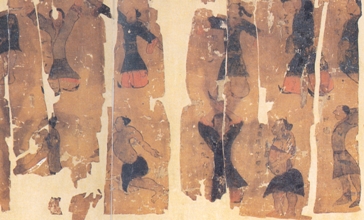
The Yinshu 引書 is an ancient collection of writings on the Chinese tradition of daoyin (guiding and pulling). From the text we know that the art of daoyin was not simply a therapy for illness, but an integral part of a regimen designed to strengthen the body — a regimen which adjusted personal hygiene, grooming, exercise, diet, sleep and sexual behaviour to the changing qualities of the four seasons. After the well-known Mawangdui medical manuscripts this manuscript, plus one other from the tomb, the Maishu 脈書 ’The Channel Book’, constitute the second richest cache of medical manuscripts recovered from the second century BCE. The techniques recorded in Yinshu can be usefully compared to the illustration from Mawangdui with the modern title Daoyin tu (chart of daoyin).
Both Yinshu and Maishu were found in tomb 247 at the Jiangling 江陵, Zhangjiashan張家山 site in modern 湖北 Hubei which was excavated in 1983/4. Yinshu was written on approximately 113 bamboo slips with 4,000 graphs in total. Other writings found with them include documents relating to judicial matters, administration, military strategy and mathematical calculations (see Christopher Cullen, Needham Research Institute Working Papers: 1 2004).
By comparing the mortuary goods with other objects excavated in local burial sites, we can give an earliest date in the second year of Empress Lu [186 B.C.] and a latest date at the beginning of the reign period of Emperor Jing [156 B.C.]. A register buried in the tomb also records that the anonymous tomb owner was bing mian ‘absent from court because of illness’ for a period taken from the first year of Hui Di [194 B.C.]. He was eventually buried with a jiuzhan ‘a pigeon staff’, a staff with a pigeon-shaped handle presented to those over eighty. He had apparently been a minor local government official who had worked during both Qin and Han dynasties.
This translation is part of a much larger long term project, which will include a translation of the Maishu in this series, as well as newly discovered medical manuscripts from Laoguanshan in Chengdu together with extensive analysis of early Chinese medicine, to be published by Brill in the Sir Henry Wellcome Asian Series.
NOTICE:
All material given here and in the appended pdf files is Copyright © Vivienne Lo 2014. Photographs of the manuscripts printed with the permission of Wenwu chubanshe 文物出版社, Beijing.The author asserts her moral right to be identified as the author of this work. It may however be read downloaded and distributed free of charge and not otherwise, for scholarly purposes only, on the conditions that the text shall not be altered in any way, and that the whole of this notice is included with any distribution of the material.
This book is published by the Needham Research Institute, 8 Sylvester Road, Cambridge UK. It has been deposited in the copyright libraries required by UK law, and has been allocated ISBN 978-0-9546771-2-1. Bound copies of the work may be purchased from the Needham Research Institute: please send enquiries to admin@nri.org.uk.
Further reading and analysis of the text by the author:
‘He Yin Yang: Xi Han yangsheng wenxian dui yixue sixiang fazhan de yinxiang’ 合阴阳:西汉养生文献对医学思想发展的影响 (Western Han ‘Nurturing Life’ Literature and the Development of Medical Thought), in Sarah Allan and Wang Tao 汪涛 (eds), Yin Yang wuxing yu Zhongguo gudai siwei moshi (Yin Yang, the Five Agents and Conceptual Models in Ancient China), (Nanjing: Jiangsu guji chubanshe, 1998), 401-23.
‘The Channels: A preliminary examination of a Lacquered Figurine from the Western Han Period’, Early China, 21 (1996), 81-123 (written with He Zhiguo 何志国).
‘Tracking the Pain: Jue and the Formation of a Theory of Circulating Qi through the Channels’, Sudhoffs Archiv, 83.2 (2000), 191-211. Also published in Chinese, in Li Xueqin 李学勤 and Xie Guihua 谢桂华 (eds), Jianbo yanjiu 简帛研究 (Research into Bamboo and Silk Manuscripts), vol. 4 (China Academy of Social Sciences [CASS] / Guilin: Guangxi shifan daxue chubanshe, 2001), 275-88.
‘Crossing the “Inner Pass”: An”Inner/Outer” Distinction in Early Chinese Medicine?’, East Asian Science,Technology and Medicine, 17 (2000), 15-65.
‘The Influence of Western Han Nurturing Life Literature on the Development of Acumoxa Therapy’, in Elisabeth Hsu (ed.), Innovation in Chinese Medicine, Festschrift in Commemoration of Lu Gwei-djen (Cambridge, CUP, 2001), 19-51.
‘Spirit of Stone: Technical Considerations in the Treatment of the Jade Body’, Bulletin of SOAS, 65.1 (2002), 99-128.
‘Lithic Therapy in Early China’, in P. Baker and G. Carr (eds), Practitioners, Practices and Patients New Approaches to Medical Archaeology and Anthropology (Oxford: Oxbow, 2002), 195-220.
‘Survey of Research into the History and Rationale of Acupuncture and Moxa since 1980’ – A New Introduction to a new edition of Lu and Needham, Celestial Lancets (London: Curzon, 2002), xxv-li.
‘Imagining practice: sense and sensuality in early Chinese medical illustration’, in F. Bray, G. Métailié and V. Dorofeeva-Lichtmann (eds), The Warp and the Weft: Graphics and Text in the Production of Technical Knowledge in China (Leiden: Brill, 2007), 387-425.
‘On the nature and purpose of Early Chinese medical writing: a study of the structure of Zhangjiashan 張家山Yinshu 引書’, in Li Jianmin 李建民 (ed.), The medical view of Chinese history (Taibei: Lianjing Press/Academia Sinica, 2008), 29-43.
‘Heavenly bodies in early China: astro-physiology in context’, in A. Akasoy, C. Burnett and R. Yoeli-Tlalim (eds), Astro-medicine: astrology and medicine, East and West (Florence: Micrologus Library, 2008), 143-87.
‘Manuscripts, Received Texts and the Healing Arts’, with Li Jianmin 李建民, in M. Nylan and M. Loewe (eds), China’s Early Empires, (Cambridge: Cambridge University Press, 2010), 367-90.
‘Acuponcture et Moxibustion’, in C. Despeux (ed.), Notices on the Dunhuang and Kotanese Medical Manuscripts (Paris: Institut des Hautes Etudes Chinoises, Collège de France, 2010), 239-84.
‘In praise of fragments: training with Paul Thompson’, in 出土文献与传世典籍的诠释–纪念谭朴森先生逝世两周年国际 学术研讨会论文集 (Excavated texts and transmitted literature: a Festschrift for Paul Thompson) [Chinese] (Shanghai: Fudan University Centre for Excavated Texts and Ancient Literature, 2010).
‘Chinese Medicine’, with Michael Stanley-Baker, in M. Jackson (ed.), The Oxford Handbook of the History of Medicine (Oxford: Oxford University Press, 2011), 150-169.
‘Training the Senses through Animating the Body in Ancient China’, in Sue Brownell (ed.), From Athens to Beijing: West Meets East in the Olympic Games, Volume I: Sport, the Body, and Humanism in Ancient Greece and China (New York: Greekworks, 2011), 67-85.
‘Han’, in TJ Hinrichs and Linda Barnes (eds), Chinese Medicine and Healing: an Illustrated History (Cambridge Mass: HUP, 2012).
To download the entire book free of charge as a pdf file (subject to the conditions in the Notice on this page) click here.
To download Adobe Reader click here.
Image: Copyright Wellcome Images L0040263
For many images of daoyin search ‘Vivienne Lo’ on http://wellcomeimages.org/