
Joseph Needham CH FRS FBA (1900-1995)
JOSEPH NEEDHAM will be remembered for his massive achievement embodied in the continuing Science and Civilisation in China series, the successive parts of which have been published by Cambridge University Press since 1954. This great work is planned as a history of science, technology and medicine in China, seen in its fullest social and intellectual context, and illuminated by a deep and sympathetic understanding of the cultures of both East and West. Through his writings he has radically changed the ways in which scholars and scientists evaluate both the history of Chinese culture, and the history of science medicine and technology understood as part of the common cultural heritage of the human race. He was undoubtedly the greatest Western sinologist of this century, and is probably the British historian best-known on a world scale. He has rightly been called “the Erasmus of the twentieth century”.
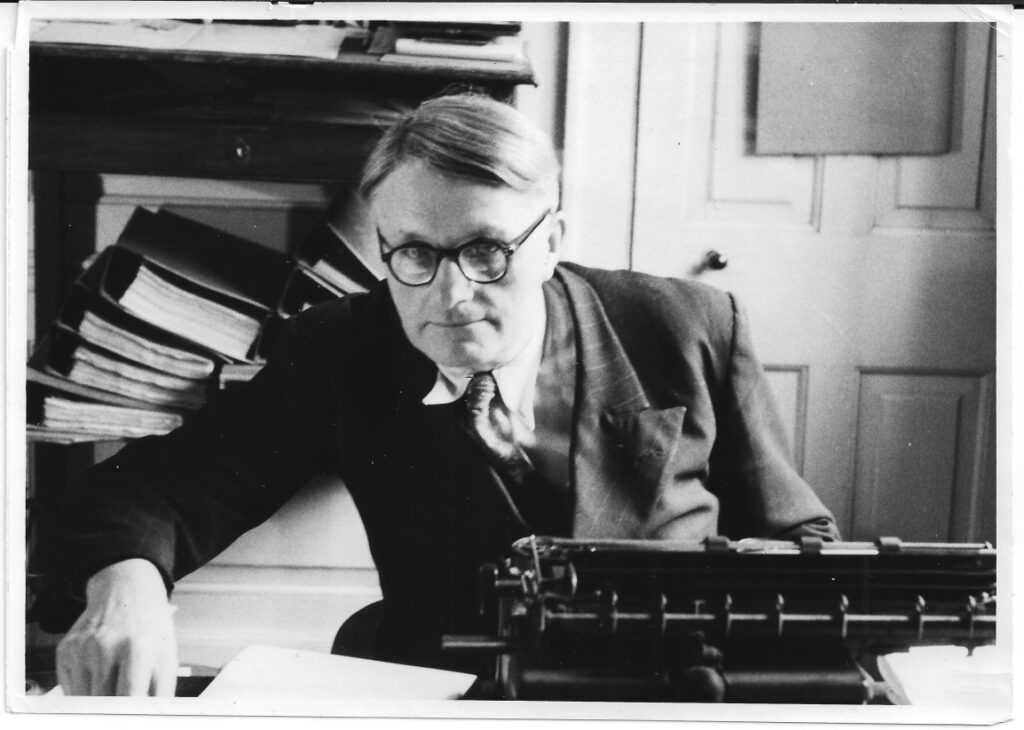
HE WAS BORN on December 9, 1900, as the only son of a Harley Street physician and a musically talented mother. After attending Oundle School he went up to Gonville and Caius College, Cambridge and read biochemistry. Caius College was to remain his academic home for the rest of his life; he was successively a research fellow, tutor, fellow and finally (1966-76) Master. For most of the first half of his life Needham was engaged in establishing himself as a chemical embryologist of distinction. The major works of this period are his Chemical Embryology (1931) and Biology and Morphogenesis (1942). But by the time this second book appeared he was already moving in the direction which was to lead him towards his life’s work.
IN THE MID 1930’s he met three young Chinese researchers who had come to work in Cambridge. The interest these bright young people aroused moved him to begin learning Chinese, and when war broke out in Europe and the East it was this connection that led him to propose that he should be commissioned to establish a Sino-British Science Co-operation Office in Chongqing, to where the Chinese government had withdrawn in the face of the Japanese onslaught. During this time he was ideally placed to study what had been accomplished by the Chinese people in the field of science and technology over their long history. What he began to learn astonished him. It became clear (for instance) that printing, the magnetic compass and gunpowder weapons were all Chinese in origin, despite the puzzlement that Francis Bacon had expressed over their beginnings when in the seventeenth century he pointed to “the force and virtue and consequences of discoveries” (Novum Organon, Book 1, aphorism 129).
AFTER THE WAR he worked with UNESCO in Paris for a while, but on his return to Cambridge he had already planned the years of work that lay ahead. He set out to answer a question that had been presenting itself to him ever more clearly for some time: why was it that despite the immense achievements of traditional China it had been in Europe and not in China that the scientific and industrial revolutions occurred? He approached Cambridge University Press with a proposal for a one-volume treatment of this subject, which they accepted, but as time went by this plan swelled to seven volumes, the fourth of which had to be split into three parts – and so it went on. Twenty-five parts in all have so far been published, and more are still on the way.
MOST OF THE EARLIER volumes were written in their entirety by Needham himself, but as time went by he gathered an international team of collaborators, to whom the completion of the project is now entrusted. As the project has broadened, so has the range of questions under investigation. It is now clear that no simple answer to Needham’s original question will be possible. The quest has opened out into an investigation of the ways in which scientific and technical activity have been linked with the development of Chinese society over the last four millennia.
THROUGHOUT THE DECADES of his research on Chinese science, Needham visited the People’s Republic of China on many occasions, collecting books and other materials essential to the project, and acting as a de facto liaison for Sino-British scientific and cultural relations, bequeathing a rich source of archival material to the institute that bears his name. Work is ongoing in bringing these materials into the public sphere, as a testament to this remarkable man.
Photos of Needham
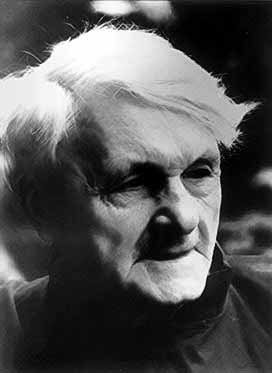
Joseph Needham 1900-1995
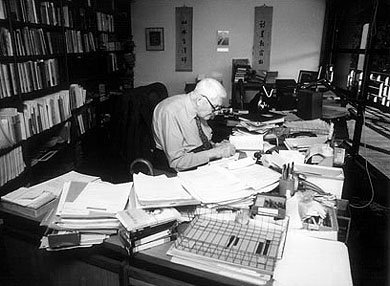
In his office at the NRI, c. 1990.
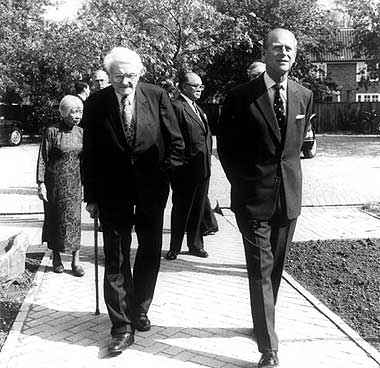
With the Duke of Edinburgh at the opening of the NRI in 1987.
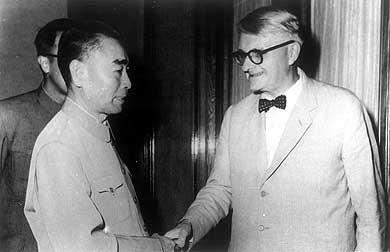
Joseph Needham meeting Zhou Enlai, 10/2/1964.
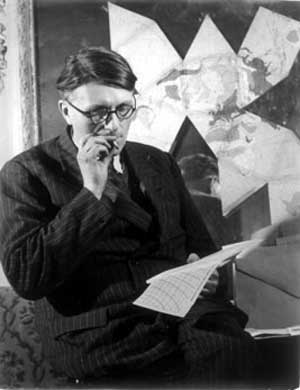
“Thinking Globally.” Joseph Needham, Director of Natural Science Division at UNESCO, 1947
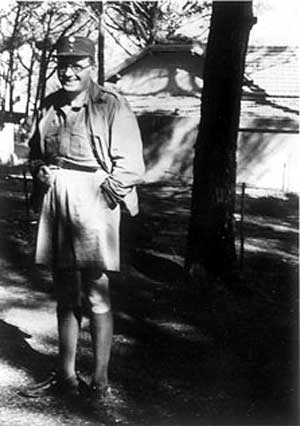
At La Capte, France, 1946. Grinning in Chinese Uniform.
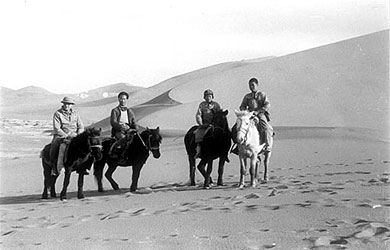
On horseback with Wu Zuoren and two boys from the Bailie School, at Dunhuang in September 1943.
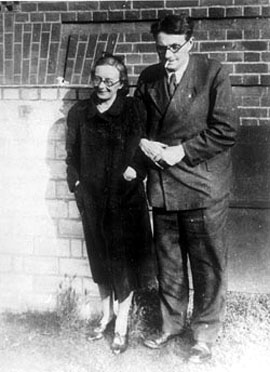
With Dorothy Needham, outside the Biochemistry Deparment, Cambridge, 1942.
Select Image:
The Life and Work of Dr. Joseph Needham (1900-1995) – Further Reading
For Dr. Needham’s work in Wartime China, see:
Science Outpost: Papers of the Sino-British Science Co-operation Office (British Council Scientific Office in China) 1942-1946
Edited by Joseph Needham and Dorothy Needham
London: The Pilot Press, 1948
This includes official reports by Dr. Needham on the work of the SBSCO, short articles published by him in Nature, extracts from his letters and travel diaries of the time, and other materials, including 60 photographs, a few of which are not among Dr. Needham’s photograph collection of the period.
He also published a shorter work, Chinese Science (London: The Pilot Press, 1945), which includes around 100 of his photographs.
For a Chinese translation of these works, see:
李约瑟游记
贵州人民出版社, 1999
Also of interest is:
“Peregrinations with Joseph Needham in China, 1943-1944” by Huang Hsing-Tsung, published in Explorations in the History of Science and Technology in China (Shanghai: Shanghai Chinese Classics Publishing House, 1982), pp. 39-76. pdf
Biographies
For a recent, popular biography of Dr. Needham, see:
The man who loved China : the fantastic story of the eccentric scientist who unlocked the mysteries of the Middle Kingdom
by Simon Winchester
New York, NY : Harper, c2008 I
ISBN: 9780060884598
Published in the UK by Viking as Bomb, book and compass : Joseph Needham and the great secrets of China, and in Chinese translation as 李约瑟 – 揭开中国神秘面纱的人 (上海科学技术文献出版社, 2009)
For a Chinese biography see:
李约瑟传
王钱国忠著
上海: 上海科学普及出版社, 2007
ISBN: 9787542734808
Bibliographies
For a list of the volumes of Dr. Needham’s Science and Civilisation in China (Cambridge University Press, 1954-) published to date, please go to the SCC page on our website.
For a bibliography of his works relating to biochemisty, experimental embryology and experimental morphology, see:
“Bibliographies of Works by Joseph Needham”, compiled by Lu Gwei-Djen, published in Explorations in the History of Science and Technology in China (Shanghai: Shanghai Chinese Classics Publishing House, 1982), pp. 703-712. pdf
For a bibliography of his other works, see:
“Joseph Needham – A Publication History”, by Gregory Blue, Chinese Science no. 14 (1997), pp. 90-132. pdf