
Joseph Needham
Capturing Wartime Moments
Dr. Joseph Needham arrived in Kunming in Southwest China, having been flown “over the hump” from India, in late February 1943. Two weeks later he flew up to Chungking (Chongqing), where the Nationalist regime had established their wartime capital. This was the culmination of a dream he had cherished since 1937, when three Chinese research scientists came to the laboratories of the Department of Biochemistry in Cambridge. After protracted discussions with the British government, it was finally agreed that he should travel to China as a representative of the British Council attached to the British Embassy in Chungking to aid the war effort there by facilitating the provision of laboratory equipment and scientific books and journals to Chinese scientists. Once there, he set about establishing the Sino-British Science Co-operation Office (SBSCO) (Zhong ying ke xue he zuo guan 中英科學合作館), also known as the Sino-British Science Co-operation Bureau, in Chungking (Chongqing), Szechuan (Sichuan) Province. By the time of his departure in April 1946, he had travelled extensively throughout Sichuan, Yunnan, and other parts of South, Southwest and Northwest China not under Japanese occupation, visiting universities and laboratories, factories and workshops, meeting people from all walks of life, especially scientists and other academics. He also took every opportunity to visit sites of historic interest and to take part in discussions with the scholars he met about his new passion – the history of Chinese science, technology and medicine – and began to collect books and other materials on the subject. For more information on Dr. Needham’s life and work, see our Further Reading page.
On his return to Europe, Dr. Needham and his wife Dorothy, who had joined him for a year at the SBSCO, edited a book about their experiences – Science Outpost: Papers of the Sino-British Science Co-operation Office (London: The Pilot Press, 1948). He also returned with travel journals, around 1200 photographs, and a large quantity of other archive material from the Office, including letters, reports to the Foreign Office (FO), and a box file of cards details the names and jobs of about 2,600 people he had met during his work.
Most of this material is held among the Needham Papers at Cambridge University Library, having been catalogued by the National Cataloguing Unit for the Archives of Contemporary Scientists [Main and Supplementary catalogues, section C].
His travel journals, photographs, card index and some other reports (such as to the Foreign Office) are part of the Needham Research Institute archive, which can be searched here.
Thanks to a project initiated in 2015, the travel journals and photographs are now available via the Cambridge University Digital Library (CUDL). Detailed links are provided below. Materials relating to his month-long visit to the Buddhist grottoes at Qianfodong, Dunhuang, in 1943 are also, thanks to support from the Dunhuang Foundation, available on the International Dunhuang Project (IDP) site (see this blogpost for expert guidance).
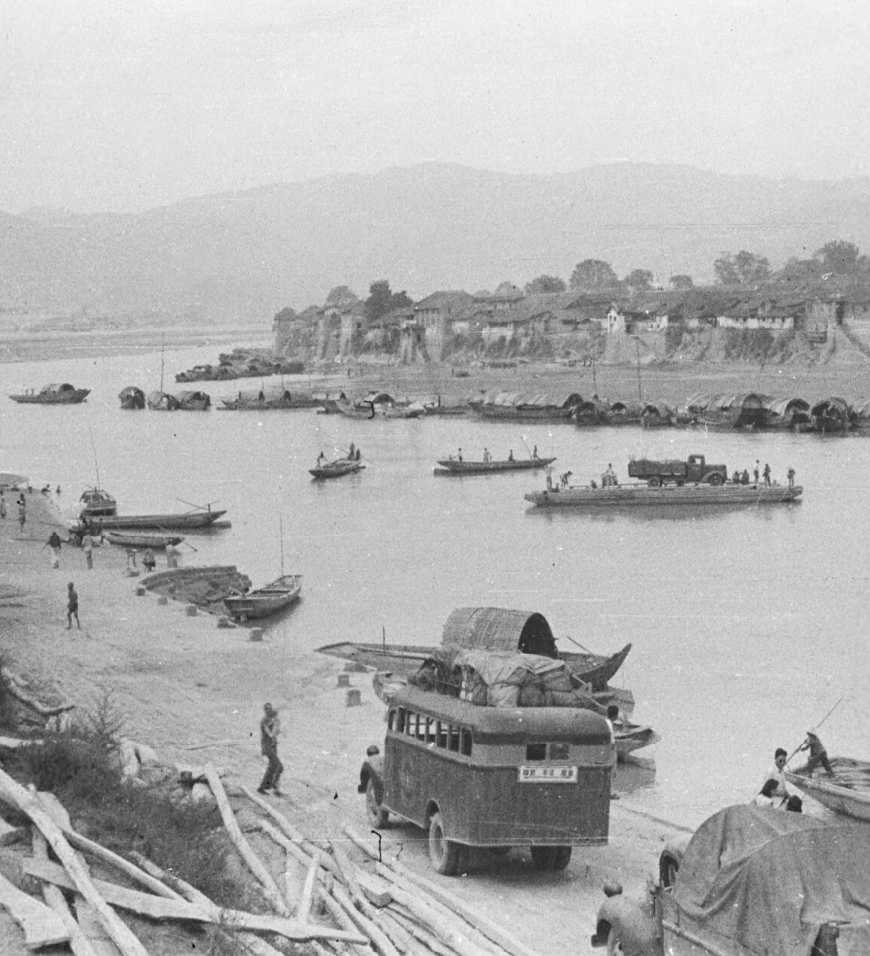
Joseph Needham Photographs – Wartime China, 1943-1946
On February 24th 1943, Dr. Joseph Needham arrived in Southwest China. He had been sent by the British Council to aid the war effort there by facilitating the provision of laboratory equipment and scientific books and journals to Chinese scientists. He soon gained permission to establish the Sino-British Science Co-operation Office (SBSCO) (Zhong ying ke xue he zuo guan 中英科學合作館), also known as the Sino-British Science Co-operation Bureau, in Chungking (Chongqing), Szechuan (Sichuan) Province. By the time of his departure in April 1946, he had travelled extensively throughout Sichuan, Yunnan, and other parts of South, Southwest and Northwest China not under Japanese occupation, visiting universities and laboratories, factories and workshops, meeting people from all walks of life, especially scientists and other academics. He also took every opportunity to visit sites of historic interest and to take part in discussions with the scholars he met about his new passion – the history of Chinese science, technology and medicine – and began to collect books and other materials on the subject.
For more information on Dr. Needham’s life and work, see our Further Reading page.
During this period Dr. Needham took around 1000 photographs, many of which he shot on the often long and arduous journeys he undertook by truck to far-flung parts of the country. All of these photographs, as well as about 200 photographs from other sources and his travel diaries are available as high resolution scans on the Cambridge Digital Library (CUDL). These photographs are also made available here according to Dr. Needham’s original groupings rearranged in chronological order:
- SZE – Szechuan (Sichuan) Province
- NW – Northwest journey
- CFT – Djiayukuan (Jiayuguan), Chienfotung (Qianfodong) and Tunhuang (Dunhuang)
- SE – Southeast journey
- SW – Southwest journey
- N – North journey
- E – East journey
Other Wartime China
- CTSAF – Chengtu Scientific Apparatus (Supply Service) Factory 成都科学仪器(供应服务)厂
- Tien – Tien Yuan Electro-Chemical Works, Ltd 天原電化工廠股份有限公司
- BA – Border Region 陕甘宁边区
- Ytang – Leshan and Emei Shan 乐山和峨眉山
- NWEPB – North-west Epidemic Prevention Bureau Vaccine Production Institute 西北防疫處疫苗研究所
- Gungho – Chinese Industrial Co-operatives (CIC) and Shantan Bailie School 中国工业合作社和山丹培黎学校
- EMB – British Embassy Staff and Guests 英国大使馆工作人员和客人
- Tseng – Educational campaign to promote improvements in tobacco growing, Sichuan 曾省 – 四川,促进烟草生产提高的教育活动
- Large – Miscellaneous large-sized photographs 其它大型照片
- Medium – Miscellaneous medium-sized photographs 其它中型照片
- SWEST – Miscellaneous photographs, most taken at scientific institutions near Kunming 西南(昆明) – 杂项照片
- Miscellaneous 杂项
Please do not reproduce the photographs for commercial use without permission. For any enquiries, contact our Librarian, John Moffett.
Users can also see a list of all the persons we have identified so far with links to the photographs in the Index of Persons, and a list of university institutions, factories, mines etc. in the Index of Institutions.
For a brief guide to searching the pages and to the structure and content of the descriptions, see searching tips.
Dr. Needham did not carry a flash and the conditions under which the exposed films had to be changed and then stored took their toll. Many of the photographs show signs of over or under exposure, double exposure, scratching to the negatives and other wear and tear, sometimes to a very serious degree. Neither was Dr. Needham systematic in the use of the camera to keep a record of his travels. These are snapshots, taken where and when he could if the camera was to hand.
The individual rolls of film and developed prints were grouped and labelled by Dr. Needham during and after his departure from China. They were not ordered in a strictly chronological sequence, and only on some did Dr. Needham make brief notes of places and people. We still do not know who many of the people in the photographs are, so if you are able to identify them, or provide any other information or corrections, please contact our Librarian, John Moffett.
Not all of the photographs in the collection were taken by Dr. Needham. Most of the photographs in ‘Other Wartime China’ came from other sources, such as research organisations, individuals, and official sources. Among these, two of these were definitely taken in August 1942 before Dr. Needham’s arrival. Where the source of these photographs is known, it has been noted. In addition, 40 photographs (Gungho 9-48) of the Shantan Bailie School 山丹培黎學校 and co-operatives of the Chinese Industrial Co-operatives (CIC) (Zhong guo gong ye he zuo she 中國工業合作社) movement were kindly donated by (Walter) Brian Harland (1917-2003) and Elisabeth Harland, though the photographs themselves appear to have come from the CIC.
We would like to express our thanks to the Andrew W. Mellon Foundation for their most generous support which enabled the cataloguing of these photographs.
Travel Journals
Travel Journals:
North-West China, August 7 – December 14 1943 [CUDL; transcript; FO report ]
Notes and sketches at Qianfodong 千佛洞, October 1943 [CUDL]
South-East China, April 8- July 1 1944 [CUDL; transcript; FO report]
South-West China, Aug.1-Oct.31, 1944 [CUDL; transcript; FO report]
North China, Aug.25-Nov.4, 1945 [CUDL; transcript; FO report]
Other resources:
We also provide here a List of Persons Joseph and Dorothy Needham met, and a List of Institutions and List of Places they visited, on the above sources. These lists include the abbreviations and romanizations Joseph uses, with pinyin equivalents and original Chinese characters. Please note that these are still in a raw state, and require much more editing. We hope, nevertheless, that they will still be of use to researchers.
Other reports and articles:
The First Year’s Working of the Sino-British Science Co-operation Bureau, February, 1944
The Second and Third Year’s Working of the Sino-British Science Co-operation Bureau, February, 1946
Report on the Condition of Scientific and Technical Installations in the Principal Eastern Cities of China, 8th April, 1946
Guide to Industrial and Mining Exhibition of National Resouces Commission, Chungking, 1944
Tienfu Coal Mines Report 天府煤礦概況, January 1944
“Peregrinations with Joseph Needham in China, 1943-1944” by Huang Hsing-Tsung, published in Explorations in the History of Science and Technology in China (Shanghai: Shanghai Chinese Classics Publishing House, 1982), pp. 39-76.
Searching Tips
These webpages have been generated from records created for the archive of documents and photographs held at the Needham Research Institute, (see ArchiveSearch), linked to 300 dpi jpeg scans of the photographs.
The photograph descriptions in these pages include the following fields:
Title: Each photograph has a descriptive title that includes people and location, where identification has been possible. These are based on Dr. Needham’s own notes on the photographs, where present, and on references in his travel diaries and other sources. The names of people, institutions and places are given first using Dr. Needham’s original romanisation form, followed by the modern pinyin romanisation and traditional Chinese characters 繁體字.
Location: The present-day name of geographical locations is used, in pinyin romanisation and simplified Chinese characters 简体字.
Date: The date is given in the form from dd–m–yr to dd–m–yr, where known.
Original caption by Joseph Needham: These are as written by Dr. Needham on the back of the photograph.
Photographer: Where known, the photographer is given, usually Joseph Needham.
Classmark: This is the original identifier for the photograph. Please quote this in any correspondence.
Searching Tips
Use the edit – find option in the toolbar for searching each page.
People: People’s names are given using Dr. Needham’s original romanisation form, followed by the modern pinyin romanisation [personal name concatenated] and traditional Chinese characters 繁體字. e.g. Chu Ko-Chen (Zhu Kezhen 竺可楨). Please note that the searching in simplified Chinese characters 简体字 will not work. The Index of Persons can also be used to locate people identified in the photographs so far.
Institutions: The names of universities and other institutions are given using Dr. Needham’s original romanisation form, followed by the modern pinyin romanisation [non-concatenated] and traditional Chinese characters 繁體字. e.g. Chekiang University (Zhe jiang da xue 浙江大學). Please note that the searching in simplified Chinese characters 简体字 will not work.
Places:
In the title field geographical place names are given using Dr. Needham’s original romanisation form, followed by the modern pinyin romanisation [concatenated] and traditional Chinese characters 繁體字. e.g. Meit’an (Meitan) 湄潭, Kweichow (Guizhou) 貴州.
In the Location field they are given in modern pinyin romanisation [concatenated] and simplified Chinese characters 简体字. e.g. Meitan 湄潭县, Zunyi 遵义市, Guizhou 贵州省.
Acknowledgements
Many people and institutions have contributed to and supported the work that has gone into making these resources available. Tracy Sinclair, Sally Church, Jiri Hudecek and Gordon Barrett all put a great deal of time and effort into producing the typescripts of the travel journals and the metadata for the photographs. Funding to support this work has come over the years from the Andrew W. Mellon Foundation, the Dunhuang Foundation, the International Dunhuang Project (IDP), the British Inter-University China Centre, the Cambridge Rivers Project, and the University of Bristol. Huw Jones, Maciej Pawlikowski and Blazej Mikula of the Digital Content Unit of Cambridge University Library brought it all to fruition on the Cambridge Digital Library.
Supporting the Needham
Research Institute
Join us in advancing research and stay updated with our latest developments.